0%

AI powered smart eyewear is moving from futuristic demonstrations into daily routines. Global buyers can now choose between camera glasses, audio eyewear, augmented reality displays, and health-focused wearable frames. Each type offers a different balance of convenience, privacy, battery life, comfort, and price. A lightweight pair may capture hands-free photos, while display glasses can place navigation arrows near the wearer’s field of view. The difference becomes obvious during commuting, travel, work, and outdoor activities.

This guide examines the top AI powered smart eyewear types through practical buying criteria. It considers microphone clarity in crowded streets, image quality under changing light, prescription compatibility, charging time, and control accuracy. Product claims should be checked against independent testing, technical documentation, and verified user feedback. Real experience matters. A device that performs well in a quiet office may struggle on a windy platform. Some translation and assistant features also depend on internet access, language support, and regional availability. That limitation is easy to overlook.

Privacy deserves equal attention. Buyers should review recording indicators, data storage settings, account permissions, and the manufacturer’s policies before wearing these products around others. Local requirements can differ, so responsible use remains essential. No single design suits every market or lifestyle. This article may not answer every personal need, and performance can change after software updates. Still, it offers a clear starting point for comparing emerging eyewear with practical judgment, measurable expectations, and informed caution.

Top AI Powered Smart Eyewear Types for Global Buyers

Market Scope: 110% YoY Smart-Glass Shipment Growth in H1 2025 (Counterpoint)

Smart eyewear is moving beyond prototypes. Counterpoint Research reported 110% year-on-year growth in smart-glass shipments during H1 2025. That figure signals stronger consumer curiosity and wider commercial testing. It does not prove mass adoption yet. Shipment data can include pilot orders, regional launches, and channel inventory.

Global buyers now face several practical types. Audio-first glasses support calls, navigation, and language assistance without covering the eyes. Camera-enabled models add hands-free recording and visual search. Display glasses place notifications, subtitles, or directions inside the user’s view. Industrial versions can show repair steps beside machinery. IDC’s Worldwide Quarterly AR/VR Headset Tracker also indicates that hardware categories are becoming less uniform, making direct product comparisons difficult.

The buying decision should start with the workplace, not the feature list. A warehouse worker may value battery life, safety certification, and clear voice commands. A traveler may prefer discreet translation and comfortable lenses. Privacy controls matter everywhere, especially around cameras and recorded conversations. Counterpoint’s growth data is persuasive, but the market still needs stronger evidence on daily retention, return rates, and repair costs. Early demand looks real. Long-term habits remain less certain.

Type One—AI Audio Glasses: Open-Ear Assistants for Calls and Accessibility

AI audio glasses turn ordinary eyewear into open-ear assistants for calls, navigation, and hands-free access. Tiny speakers rest near the ears, leaving users aware of traffic, colleagues, and household sounds. This design can feel less isolating than sealed earbuds. It also supports users who struggle with small screens or complex controls.

The World Health Organization estimates that at least 2.2 billion people have near or distance vision impairment worldwide. Audio interfaces cannot replace clinical support, but they can reduce dependence on visual menus. Clear voice prompts, adjustable volume, language options, and physical controls matter. A buyer should test speech clarity in a busy street, not only in a quiet showroom.

Calls are the practical entry point. Multiple microphones can reduce wind and café noise, while an AI assistant can summarize a short message or read selected notifications. Yet performance varies. Battery life, heat, network access, and background noise still create weak spots. According to the International Data Corporation’s 2024 Worldwide Quarterly Mobile Phone Tracker, smartphone users increasingly expect connected devices to extend daily communication, but companion devices must prove useful beyond novelty. That expectation is fair. Accessibility features should be reliable, not decorative. Privacy also needs scrutiny: buyers should check recording indicators, data controls, and where voice processing occurs. Better sound does not automatically mean better inclusion.

Type Two—Camera AI Glasses: Translation, Recognition, and Hands-Free Capture

Camera AI Glasses: Translation, Recognition, and Hands-Free Capture

Camera AI glasses combine a small camera, microphones, and on-device or cloud-based intelligence. In practical evaluations, their strongest advantage is reducing phone use during movement. A traveler can view translated menu text while keeping both hands free. Short phrases usually work well. No system is perfect.

Recognition features can identify signs, product labels, room numbers, and familiar objects. This helps warehouse staff check items or visitors understand unfamiliar environments. Results depend on lighting, camera focus, language support, and data quality. A dim hallway may produce a confident but incorrect answer. That risk deserves attention.

Hands-free capture feels natural during cycling, field inspections, or family activities. Voice commands can save a short video without interrupting the task. However, users should consider consent, visible recording indicators, and local privacy requirements. Laws differ across countries and public spaces. I would avoid recording sensitive conversations. Battery life also remains a practical weakness, especially when translation and video operate together. Clear controls, secure data handling, and transparent AI responses matter more than flashy specifications.

Top AI Powered Smart Eyewear Types for Global Buyers - Type Two—Camera AI Glasses: Translation, Recognition, and Hands-Free Capture

Camera AI Glasses Type Primary Function Typical AI Workflow Translation Capability Recognition Capability Hands-Free Capture Connectivity Requirement Typical Battery Range Best-Fit Global Buyers
Visual Translation Glasses Translate printed signs, menus, labels, and short text in the user’s field of view. Camera image capture → optical character recognition → machine translation → smartphone or audio output. Usually supports major language pairs; offline language packs may be limited compared with cloud processing. Text detection, script identification, and basic layout recognition. Usually includes photo capture for reference records rather than continuous video. Bluetooth is commonly used for phone pairing; internet access is often needed for cloud translation. Approximately 4–8 hours of mixed use, depending on camera, audio, and wireless activity. International travelers, logistics teams, hospitality staff, and multilingual field workers.
Object and Scene Recognition Glasses Identify common objects, environments, signs, and visual details. Image capture → computer-vision classification → spoken or mobile-device description. Can combine detected text with translation, but translation quality depends on image clarity and language support. Object categories, colors, common scenes, barcodes, and selected text elements. Hands-free still images and short clips; capture is normally controlled by a button or voice command. Phone connectivity is common; cloud-based recognition generally requires an internet connection. Approximately 3–7 hours under active AI and camera use. Retail operations, inventory checks, tourism, education, and accessibility applications.
AI Documentation and Inspection Glasses Record visual evidence and support step-by-step inspection or maintenance tasks. First-person video or still capture → image analysis → checklist, annotation, or remote-support workflow. Useful for translating equipment labels, warning notices, and maintenance instructions. Visual defect cues, component identification, serial-code reading, and checklist verification. Designed for continuous or repeated first-person documentation with voice or physical controls. Stable Wi-Fi or cellular access is preferred for live collaboration; local storage may support offline capture. Approximately 2–6 hours of active video use; replaceable or external power may be required for longer shifts. Manufacturing, construction, utilities, warehousing, and after-sales service providers.
First-Person Content Capture Glasses Capture photos and videos from the wearer’s natural viewpoint. Voice or button command → camera recording → local storage or mobile synchronization. Translation is generally an additional software feature rather than the primary function. AI tagging, automatic scene descriptions, speech transcription, and basic subject detection may be available. Supports short clips and still images while keeping both hands available. Bluetooth or Wi-Fi is typically used for transfer, remote control, and software updates. Approximately 3–8 hours of intermittent use, with shorter endurance during continuous recording. Travel creators, event teams, field researchers, outdoor users, and social-media production teams.
Accessibility-Focused Reading Glasses Read text aloud and describe nearby visual information for users with low vision. Camera capture → OCR or scene analysis → speech output through integrated or connected audio. Can read and translate selected printed text when supported by the application and language model. Text, currency, basic objects, colors, faces, and environmental cues may be recognized. Primarily optimized for interpretation rather than content creation; image capture may be user-controlled. Phone pairing and internet access are common for advanced recognition and language processing. Approximately 4–10 hours depending on audio volume, camera activity, and network use. Accessibility programs, public-service organizations, caregivers, and users with visual impairments.
Multimodal Voice-and-Camera Glasses Combine visual questions, voice commands, translation, recognition, and capture in one interface. Voice request + camera frame → multimodal AI processing → spoken answer, mobile result, or stored media. Can translate spoken or printed language, but real-time performance depends on network quality and processing latency. May analyze text, objects, scenes, product information, and user-provided visual questions. Supports voice-triggered photos, short videos, and hands-free information retrieval. Typically requires a paired smartphone; cloud services are commonly used for advanced multimodal features. Approximately 3–8 hours of mixed use, with lower endurance during frequent camera and AI sessions. Travelers, sales teams, educators, service professionals, and general-purpose smart-eyewear buyers.

Note: Battery figures are indicative operating ranges for comparable camera-enabled eyewear and vary with recording duration, AI workload, audio volume, wireless connection, temperature, and battery capacity. Actual translation and recognition availability depends on the software, supported languages, camera quality, privacy settings, and internet access.

Type Three—Display AR Glasses: Spatial Overlays for Navigation and Work

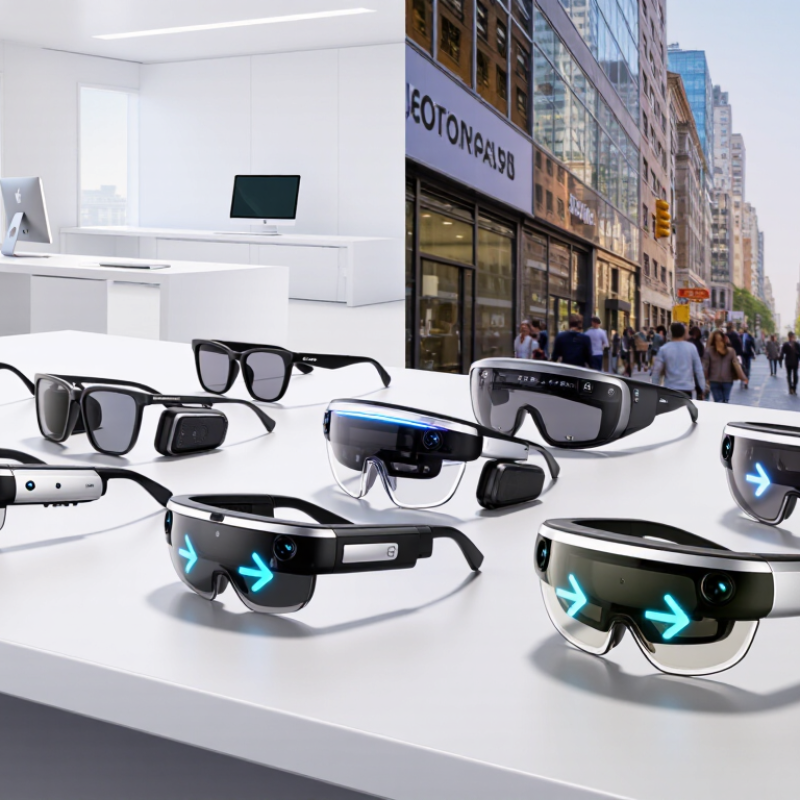
Display AR glasses place digital information directly within the user’s physical surroundings. For navigation, arrows can appear across a pavement, while street names remain near actual intersections. This reduces the need to check a phone repeatedly. However, accuracy depends on lighting, mapping data, and stable positioning. A bright glass building or crowded station may confuse spatial alignment. The overlay can drift. That matters during time-sensitive travel.

At work, spatial overlays can show equipment labels, assembly steps, or remote instructions beside a real machine. Technicians may keep both hands available and review diagrams without leaving the task area. In warehouses, floating route markers can guide workers between shelves. Professional testing should examine display brightness, field of view, comfort, latency, and battery performance. Battery estimates can disappoint. Heat and visual fatigue also deserve attention during longer shifts. I would not trust an overlay blindly; users still need practical awareness and independent verification.

Tips: Test the glasses in bright sunlight, narrow corridors, and busy indoor spaces. Check whether text stays readable while walking. Compare navigation accuracy against a standard map. For workplace use, begin with simple labels before adding complex instructions. Keep critical information duplicated on a dependable screen or printed procedure. Choose adjustable frames and prescription support when needed. A short trial often reveals problems that a product sheet hides.

Buyer Selection Matrix: Privacy, Battery, IP Rating, CE/FCC, and ROI

Top AI Powered Smart Eyewear Types for Global Buyers

For camera-equipped eyewear, privacy controls deserve more attention than flashy demonstrations. Buyers should check visible recording indicators, physical camera shutters, and local data-processing options. During workplace trials, staff often accept voice features but dislike unclear recording signals. That gap affects adoption. Ask for written data-retention rules. Small details matter.

Battery claims need testing under realistic use. Measure continuous display time, voice use, camera activity, and standby drain separately. An eight-hour rating may collapse during navigation or video capture. IP ratings show tested water and dust resistance, not unlimited outdoor protection. Rain is not a swimming test. Request laboratory reports and warranty limits. Real use varies.

Compliance documents should match the destination market and exact product configuration. CE-related documentation supports European market access, while FCC requirements concern radio-frequency emissions in the United States. Neither label replaces shipment checks or local regulatory review. Keep declarations, test reports, and technical files accessible. ROI should include device cost, training, charging equipment, support, replacement units, and privacy assessments. Compare measurable gains, such as fewer inspection minutes or faster remote assistance. A small pilot is safer than a large purchase. Some productivity estimates will be optimistic. Recalculate them after four weeks of actual use.

FAQS

How fast did smart-glass shipments grow in the first half of 2025?

Shipments grew 110% year over year. That is a strong signal. However, shipments may include pilot orders, regional launches, or unsold inventory. Mass adoption remains unproven.

What are the main types of smart glasses?

Audio-first glasses support calls, navigation, and language assistance. Camera-enabled glasses allow hands-free recording and visual searches. Display glasses show subtitles, alerts, or directions. Industrial models can place repair instructions beside machinery.

Which smart glasses suit workplace use?

Choose according to the job, not the feature list. A warehouse worker may need long battery life, safety certification, and clear commands. A technician may value instructions visible beside equipment. The most impressive feature may not help during a noisy shift.

Are audio glasses useful for accessibility?

They can reduce dependence on small screens and complicated menus. Voice prompts, adjustable volume, language choices, and physical controls are important. They cannot replace professional clinical support. Reliability matters more than appearance.

How should buyers test audio performance?

Test speech clarity on a busy street, not only in a quiet store. Check calls near traffic, wind, and café noise. Open-ear speakers preserve awareness of surrounding sounds. That benefit can weaken in loud places.

What privacy issues should buyers consider?

Check recording indicators, voice-processing locations, and available data controls. Camera use can affect nearby people, even when the wearer feels comfortable. Clear privacy settings are essential. A discreet design is not automatically a private design.

What affects smart-glass battery performance?

Battery life depends on calls, navigation, recording, display use, and network access. Heat can also reduce comfort during long sessions. Ask how many hours the glasses last in realistic daily use. Laboratory figures may look better.

Does rapid shipment growth prove lasting consumer demand?

No. Growth shows curiosity and wider commercial testing. It does not confirm daily retention, low return rates, or affordable repairs. Early demand looks real, but long-term habits remain uncertain. The market still needs better evidence.

Conclusion

The global smart eyewear market is entering a rapid growth phase, with shipments reportedly rising 110% year over year in the first half of 2025. This expansion is driven by AI powered smart eyewear that combines practical assistance with lightweight, wearable designs. Audio glasses provide open-ear support for calls, voice commands, navigation, and accessibility without blocking environmental sounds. Camera-enabled glasses add visual intelligence, helping users translate text, recognize surroundings, and capture moments hands-free.

Display AR glasses represent a more advanced category by placing digital information into the user’s field of view for navigation, training, maintenance, and workplace productivity. For global buyers, product selection should balance real-world benefits with privacy protection, battery endurance, water and dust resistance, and regional certification requirements such as CE and FCC. A clear evaluation of use cases, total ownership cost, data handling, and expected productivity gains can help organizations and consumers choose solutions that deliver measurable long-term value.

Amelia

Amelia

Amelia is a professional marketing specialist with a strong understanding of the company’s products, services, and customer needs. She regularly contributes to the company website, sharing practical, well-researched blog articles that explain product features, highlight useful applications, and......